


The strangest thing happened in the hot summer afternoon near Erie in July of 1861.
A strange story, yet to anyone who loves Forteana it is an oddly familiar one as well.
In the suburban Erie township of Girard there was a large summer picnic at the Battles estate that July summer day in 1861. The Battles were a wealthy banking family in the small rural town on the Western edge of Erie County. Just 3 years earlier they had constructed the large Italianate style farmhouse that was a showcase in the local community. That summer was one of celebration; Rush Sobieski Battles had just wed Charlotte Webster, his banking partner’s sister, in late March. They had recently returned from their honeymoon and hosted that lavish feast on their lawn on that hot summer day.
After the picnic two gentlemen were taking a leisurely stroll in the acreage behind the farmhouse to enjoy the cool early evening breeze. As they descended the tiny slope in the landscape that ended in at the edge of a small creek they saw something flailing in the water a few meters up stream.
It was a body.
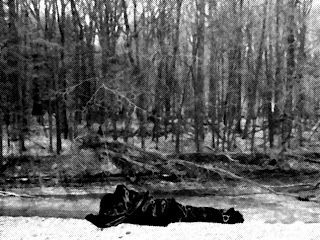
They rushed to the bodies side and pulled it from the creek. The body was that of a young man dressed in a military uniform. As the crown gathered to view the body, no one in the small close knit community recognized him. Then they realized the oddest part of this mystery, for the dead lad wore the military uniform of a soldier in the War of 1812…some 48 years out of time!
The uniform was new, its colors were bright and the uniform fit perfectly. The boy was never identified and the body was buried in a local cemetery. The small creek behind the Battles Mansion forever after was known by its new name, Dead Man’s Creek.
Erie Pennsylvania and the War of 1812 are forever linked because of the prominent role the city played in the naval victory of the War.
This fascinating story has been spread by word of mouth for over 100 years in the small community of Girard Pennsylvania. It has also been reported in local historian Stephanie Wincik’s book “The Ghost’s of Erie County”, however her reference work was ‘local folk tales’.
So I took to the library to see if there was any evidence in newspapers of the time that told of this displaced soldier from a War long passed.
In the summer of 1861 the American Civil War had just begun. The local newspaper, the Erie Times was full of reports of the mustering troops from the local area heading into the front lines and preparing for conflict. Every soldier entering active duty was duly noted for their service in those old local papers. And when it came to other pursuits of every day life outside of the War the attention to detail was not lacking either. While perusing the papers from 1859 to 1863 I noticed that even the most mundane news was not left unnoticed. It was front page news in the local section when someone would merely fall off their horse. In our media and entertainment soaked society today it is hard to conceive such trivialities would garner such interest, but at that time this was the only source of news and entertainment to be had outside of the theater.
Nowhere in all the editions from those years did I find any reference to a body of a mysterious soldier found anywhere in the County of Erie, let alone Girard specifically. Since the War was raging and local patriotism was at a fever pitch it is unimaginable that there would be no reference to this incident…unless it did not happen.
I contacted the Girard cemetery to ask if there were any such burials of an unknown soldier in that time frame, and there were not. Of course there were many other smaller cemeteries around at that time so it could be conceivable that the boy for 1812 was buried at some other location, but it would be almost unimaginable that an unknown soldier-no matter what the mystery surrounded his demise- would not be buried with honor in the main cemetery in the center of town only a short distance from the place that the incident took place.
So did it happen?
It reminds me of a few other rather famous…or should I say infamous incidents of displaced people roughly within the same time period.
Broadcaster and writer of the paranormal, Frank Edwards in his book "The Strangest of All"
tells of the story of young Oliver Larch,
"Christmas eve of 1889 found the countryside around South Bend, Indiana, covered with several inches of soft snow. A few miles out of the city at the farm where Oliver Larch lived with his parents, an old-fashioned Christmas party was under way.
The family minister and his wife were there, along with a circuit judge from South Bend and an attorney from Chicago who had lone been a friend of the family. After dinner they all retired to the parlor for conversation and for singing to the accompaniment of the old-style pump organ which Mrs. Larch played quite well, having been church organist for many years…
Outside the snow had stopped falling. It was about five or six inches deep, a soft and fluffy blanket that lay as as it fell, for there was no breeze on this black, starless night.
A few minutes before eleven O’clock, Oliver’s father noticed that the grey granite bucket which held the drinking water needed filling. He asked Oliver to run out to the well and bring in a bucket of fresh water. Oliver slipped on a pair of overshoes and went out the side door as his father went back into the parlor to be with the guests.
About ten seconds after Oliver closed the door behind him the adults in the front room heard him scream for help. They ran out the same door Oliver had used. Mr. Larch brought a kerosene lamp which sent its flickering yellow rays out over the snow for a few feet. Scream after scream chilled the little gathering.
‘Help! Help! They’ve got me! Help! Help! Help!’
The witnesses afterward agreed that the cries for help were coming from overhead. Somewhere up there in the stygian blackness Oliver Larch was in mortal fear, his screams growing fainter and fainter until they finally became inaudible.
By the light of the lam the men made out Oliver’s footprints in the snow. He had gone about half way to the well, which was about seventy-five feet from the house across the open yard, when his tracks ended abruptly. The grey granite bucket lay on its side in the snow about fifteen feet away on the left side of Oliver’s track. There were no other marks of any kind in the soft snow.
Just Oliver’s footprints…and the bucket…and silence."
Did this event really happen?
In his blog "A Different Perspective" author Kevin D. Randle writes that in investigating this case he came to many of the same roadblocks to verification of this displaced boy that I had faced in my efforts for the Girard story.
There are no newspaper accounts of the incident. In fact local reporters Francis K. Czyzewski and Sarah Lockerbie both wrote investigative reports for various newspapers in the 1960s about the incident and came to the conclusion that it had never happened. However there is evidence that Randle uncovers that points that the story goes back to at least 1906 if not earlier.
Another story popular in the 50s in a similar vein is that of the disappearance of David Lang. Again Frank Edwards in another book, “Stranger than Science” recounts the bizarre tale of the man’s disappearance. Mr. Lang was walking across a field on his farm to meet Judge August Peck who was coming down the road in a horse and buggy. Frank Edwards writes that:
“David Lang had not taken more than half a dozen steps when he disappeared in full view of all those present. Mrs. Lang screamed. The children, too startled to realize what had happened, stood mutely. Instinctively, they all ran toward the spot where Lang had last been seen a few seconds before. Judge Peck and his companion, the Judge’s brother-in-law, scrambled out of their buggy and raced across the field. The five of them arrived on the spot of Lang’s disappearance almost simultaneously. There was not a tree, not a bush, not a hole to mar the surface. And not a single clue to indicate what had happened to David Lang.
The grownups searched the field around and around, and found nothing. Mrs. Lang became hysterical and had to be led screaming into the house. Meanwhile, neighbors had been altered by the frantic ringing of a huge bell that stood in the side yard, and they spread the alarm. By nightfall scores of people were on the scene, many of them with lanterns. They searched every foot of the field in which Lang had last been seen a few hours before. They stamped their feet on the dry hard sod in hope of detecting some hole into which he might have fallen—but they found none.
David Lang was gone. He had vanished in full view of his wife, his two children, and the two men in the buggy. One second he was there, walking across the sunlit field, the next instant he was gone.”
It is reported that the grass where Lang disappeared had turned yellow as if some weird form of energy had whisked him off to another dimension. A dimension that was close at hand for it was also reported that Mr. Lang’s daughters still had conversations with the man at the site for day before his voice finally faded into nothingness.
Of course many familiar with Fortean stories from the last century know that this story at least is a confirmed hoax. The story of David Lang first appears in July 1953 issue of Fate magazine, authored by mystery writer Stuart Palmer. The similarities to author Ambrose Bierce’s work “The Difficulty of Crossing a Field,” in the 1893 collection of stories “Can Such Things Be?” make this story an obvious fake, and a plagiarized one at that. Some would also contend that the Larch disappearance was also influenced by Ambrose Bierce.
However here is where the real oddness of these fanciful stories meets unexplained reality.
In December of 1913 Ambrose Bierce, a War veteran, joined Mexican revlutionary Pancho Villa’s army as a literary observer. On December 26, 1913 Bierce wrote his friend Blanche Partington and disappeared off the face of the earth.
Life imitating art? Or a foreseen destiny manifest?
Until Next Time,
Pastor Swope
http://theparanormalpastor.blogspot.com ... -ones.html


